



How Learning Skills with AI


The Global Shift Toward AI-Assisted Learning
Artificial intelligence is no longer viewed solely as a tool for automation. Instead, it has evolved into an intelligent learning companion capable of helping students, professionals, entrepreneurs, and lifelong learners build knowledge more efficiently.
Several global trends have accelerated this transformation:
- Rapid digital transformation across industries.
- Growing demand for continuous upskilling.
- Shorter life cycles of technical skills.
- Increased availability of AI-powered educational platforms.
- Remote and hybrid learning becoming mainstream.
According to recent workforce research by the World Economic Forum, technological change continues to reshape labor markets, making continuous learning one of the most valuable career investments. Many emerging roles now require workers to combine technical expertise with AI-related competencies.
Rather than replacing education, AI is expanding access to high-quality learning resources for millions of people worldwide.
Why Traditional Learning Methods Are No Longer Enough
For decades, education followed a relatively fixed model:
- Teacher-centered instruction
- Standardized textbooks
- Uniform examinations
- Limited personalization
- Slow feedback cycles
Although this model remains valuable for foundational education, it often struggles to meet the demands of today’s rapidly evolving job market.
Modern industries introduce new technologies at an unprecedented pace. Programming languages evolve, marketing strategies change, cybersecurity threats emerge daily, and AI applications continuously redefine workplace expectations.
Traditional education often cannot update curricula quickly enough.
AI addresses this challenge by providing learners with continuously updated information, adaptive exercises, and personalized recommendations based on individual learning progress.
Instead of waiting weeks for assessment results, learners receive immediate feedback that helps correct mistakes before they become long-term habits.
The Science Behind AI-Powered Learning
The effectiveness of AI in education is not simply based on convenience. It aligns with decades of cognitive psychology and educational research regarding how people learn most effectively.
1. Personalized Learning Improves Knowledge Retention
Educational psychology has consistently shown that learners retain information more effectively when instruction matches their existing knowledge level.
AI systems analyze:
- Learning speed
- Quiz performance
- Mistake patterns
- Memory retention
- Preferred learning style
- Practice frequency
Using this information, AI recommends lessons that match the learner’s current abilities instead of presenting identical material to everyone.
For example:
A beginner learning Python programming receives explanations focused on variables and loops, while an advanced learner may immediately move toward APIs, automation, or machine learning projects.
This personalized progression reduces frustration and improves motivation.
2. Immediate Feedback Accelerates Improvement
Traditional classrooms may require days or weeks before assignments are graded.
AI dramatically shortens this feedback loop.
Instead of waiting for an instructor, learners receive:
- Instant corrections
- Error explanations
- Alternative solutions
- Personalized recommendations
- Additional practice questions
Research in educational assessment consistently demonstrates that timely feedback strengthens learning because students can correct misunderstandings while the material is still fresh in memory.
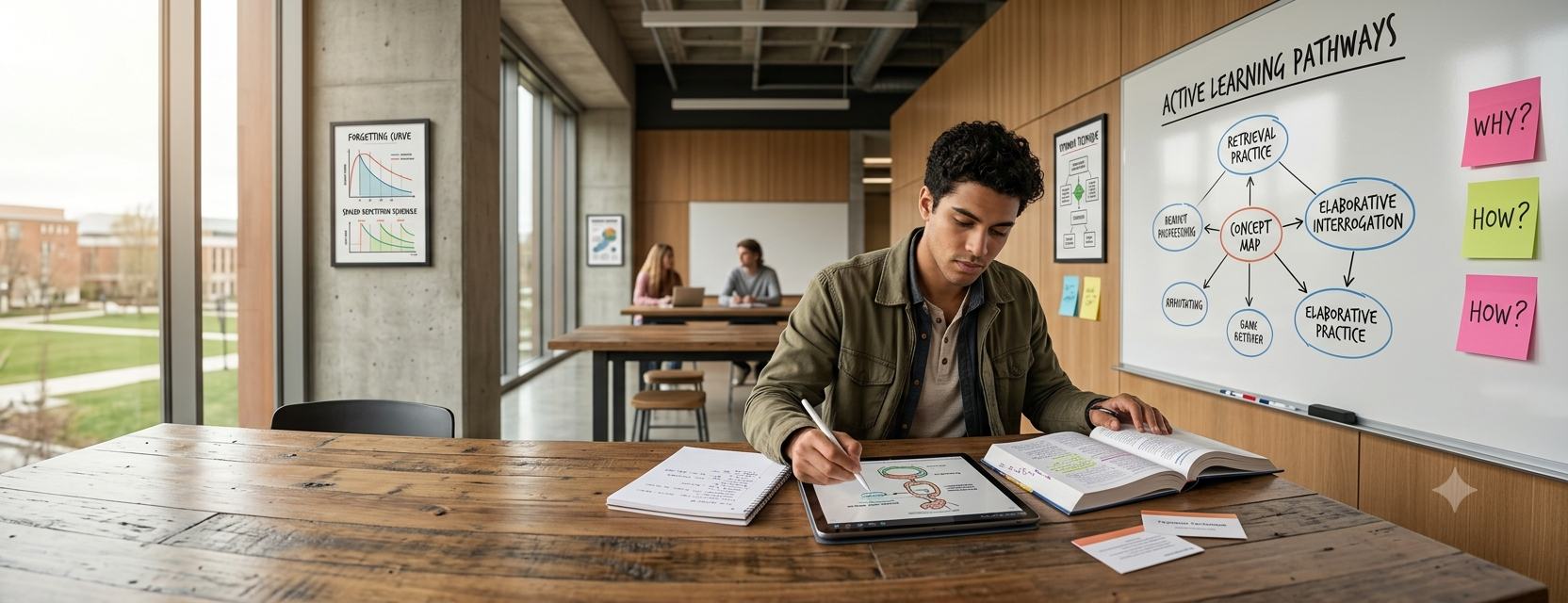
3. Active Learning Produces Better Results
Passive learning often involves reading notes or watching lectures without interaction.
Active learning requires learners to:
- Solve problems
- Answer questions
- Explain concepts
- Practice repeatedly
- Apply knowledge
Modern AI learning platforms encourage this active engagement through interactive conversations, adaptive quizzes, simulations, and project-based exercises.
Rather than simply consuming information, learners actively construct knowledge.
4. Spaced Repetition Enhances Long-Term Memory
Memory research has repeatedly shown that reviewing information at increasing intervals improves long-term retention.
Many AI-powered educational systems automatically schedule review sessions based on:
- Previous performance
- Forgetting probability
- Difficulty level
- Learning history
Instead of reviewing everything equally, learners spend more time strengthening weaker concepts.
This intelligent scheduling makes studying more efficient.
What Makes AI Different From Traditional Search Engines?
Many people assume AI simply replaces search engines.
In reality, the two serve different purposes.
| Traditional Search | AI-Assisted Learning |
|---|---|
| Provides links | Explains concepts |
| Requires users to evaluate multiple sources | Synthesizes information into understandable answers |
| Limited personalization | Adapts explanations to learner level |
| Passive information retrieval | Interactive learning experience |
| No continuous guidance | Supports ongoing skill development |
For example, a learner searching for “How does recursion work?” may receive dozens of articles through a search engine.
An AI tutor can instead explain recursion step by step, provide examples, generate practice problems, identify mistakes, and adjust explanations until the learner understands the concept.
This interactive capability is one of AI’s most significant educational advantages.
The Rise of AI Literacy as a Core Skill
Until recently, digital literacy referred primarily to using computers, email, and productivity software.
In 2026, AI literacy has become an increasingly important extension of digital literacy.
AI literacy involves understanding:
- How AI systems generate responses.
- The strengths and limitations of AI.
- Responsible use of AI tools.
- Prompt writing techniques.
- Verification of AI-generated information.
- Ethical considerations and privacy awareness.
Governments, universities, and employers are increasingly recognizing AI literacy as an essential workplace competency.
Importantly, AI literacy is not limited to software engineers. Professionals in healthcare, education, finance, marketing, law, engineering, and public administration are all expected to use AI responsibly in their daily work.
Research Shows AI Can Improve Learning Outcomes—With the Right Approach
The growing body of research suggests that AI can significantly enhance learning when used to support, rather than replace, human thinking.
Studies and policy guidance highlight several consistent benefits:
- More personalized instruction tailored to individual progress.
- Faster identification of learning gaps through continuous assessment.
- Greater learner engagement with interactive exercises and simulations.
- Improved access to educational support regardless of location or schedule.
- Enhanced opportunities for lifelong learning and career reskilling.
However, researchers also emphasize that successful learning still depends on critical thinking, curiosity, and independent practice. AI is most effective when learners actively question responses, verify important information, and apply new knowledge through real-world projects instead of relying on AI to produce answers without understanding them.
This balanced approach reflects the direction many educational institutions and employers are taking in 2026: AI is treated as a powerful learning assistant, not a substitute for human judgment or expertise.
Why This Matters in 2026
The pace of technological change means that the ability to learn new skills quickly has become as valuable as the skills themselves. Whether someone is preparing for a university degree, switching careers, launching a business, or advancing in their current profession, AI offers tools that can shorten the learning curve and make education more accessible.
At the same time, success depends on using AI thoughtfully-combining its speed and adaptability with human creativity, critical thinking, and practical experience.
How AI Is Transforming the Way People Learn Different Skills
One of AI’s greatest strengths is that it can adapt to almost any subject. Whether someone wants to learn a foreign language, write better content, analyze business data, or become a software developer, AI provides personalized guidance that was previously available only through private tutors or expensive training programs.
Unlike traditional online courses that follow a fixed curriculum, AI adjusts explanations, exercises, and feedback according to each learner’s progress. This flexibility allows beginners and advanced learners to study at their own pace without feeling overwhelmed or held back.
The following sections explore how AI is changing skill development across some of the world’s fastest-growing career fields.
1. Learning Programming and Software Development with AI
Software development has become one of the biggest beneficiaries of AI-assisted learning. Programming used to involve reading textbooks, searching documentation, and spending hours debugging errors without understanding why code failed.
Today, AI-powered assistants can explain concepts in plain language, generate sample code, identify programming mistakes, and recommend improvements.
Instead of simply providing answers, effective learners use AI to understand:
- Why code works
- Why errors occur
- Alternative programming approaches
- Performance optimization
- Industry best practices
Example Learning Journey
Imagine a beginner learning Python.
Instead of reading 400 pages before writing code, they can:
Week 1
- Learn variables
- Practice loops
- Solve simple exercises
Week 2
- Build a calculator
- Create a to-do application
- Learn debugging
Week 3
- Work with APIs
- Understand automation
- Build small real-world projects
Throughout this journey, AI provides explanations, quizzes, debugging support, and project ideas, making the learning process more interactive than traditional self-study.
Why This Matters
Industry surveys consistently show that employers value developers who can solve problems rather than memorize syntax. AI encourages this by shifting the focus from remembering every command to understanding programming logic and applying it effectively.
2. AI Is Revolutionizing Language Learning
Learning a new language has traditionally required classrooms, grammar books, and occasional speaking practice.
AI has changed this dramatically.
Modern AI learning systems can simulate conversations, correct pronunciation, explain grammar mistakes, and generate personalized vocabulary exercises.
Instead of practicing with static examples, learners can engage in realistic scenarios such as:
- Airport conversations
- Job interviews
- Business meetings
- University presentations
- Hotel reservations
- Medical emergencies
This contextual learning improves both confidence and practical communication skills.
Research Insight
Second-language acquisition research has long emphasized that frequent interaction and immediate feedback accelerate fluency. AI supports both by enabling unlimited practice opportunities, something that is difficult to achieve in conventional classroom settings.
3. Writing Skills Are Becoming Smarter with AI
Writing is no longer limited to checking grammar.
AI can now support nearly every stage of the writing process, including:
- Brainstorming ideas
- Structuring articles
- Improving clarity
- Simplifying complex language
- Enhancing readability
- Identifying logical inconsistencies
- Suggesting stronger headlines
However, experienced writers use AI differently from beginners.
Instead of asking AI to write an entire article, professional writers often use it to:
- Generate outlines
- Explore multiple perspectives
- Find gaps in arguments
- Improve sentence flow
- Check consistency
- Refine tone for different audiences
This approach helps maintain originality while improving efficiency.
Human Expertise Still Matters
Search engines and readers increasingly value content that demonstrates first-hand experience, critical thinking, and unique insights. AI can assist with drafting and editing, but genuine expertise, original analysis, and credible sources remain essential for producing high-quality work.
4. AI Makes Learning Data Analysis More Accessible
Data analysis was once considered a highly specialized skill requiring advanced knowledge of statistics and programming.
AI has lowered many of these barriers by helping learners:
- Interpret datasets
- Create visualizations
- Explain statistical concepts
- Generate formulas
- Identify trends
- Build dashboards
Instead of memorizing every statistical method, learners can focus on understanding how to interpret results and make informed decisions based on evidence.
For businesses, this means employees can develop analytical skills more quickly and contribute to data-driven decision-making even if they are not professional data scientists.
5. Creative Skills Are Evolving Alongside AI
Creativity remains a distinctly human strength, but AI is expanding what creators can accomplish.
Designers, photographers, musicians, and video editors now use AI to accelerate repetitive tasks while focusing more on originality and storytelling.
Examples include:
- Generating design concepts
- Removing image backgrounds
- Enhancing photo quality
- Editing videos
- Producing subtitles
- Creating storyboards
- Exploring multiple design variations
Importantly, AI does not replace creativity—it increases creative productivity.
Professionals still make the final decisions regarding aesthetics, branding, and audience engagement.
6. Business Professionals Are Learning Faster
Business education has become increasingly practical through AI-powered simulations and coaching.
Professionals can now practice:
- Negotiation
- Leadership
- Marketing strategy
- Sales conversations
- Customer service
- Financial planning
- Business communication
Instead of reading theoretical examples, learners receive customized scenarios based on realistic workplace situations.
For example, a marketing professional can ask AI to simulate customer personas, evaluate advertising campaigns, or suggest ways to improve conversion rates while explaining the reasoning behind each recommendation.
AI Encourages Microlearning
One of the most important educational trends in 2026 is microlearning—learning in small, focused sessions rather than long study marathons.
Research in cognitive science suggests that shorter, concentrated learning sessions often improve attention and long-term retention.
AI supports microlearning by delivering:
- Five-minute lessons
- Daily quizzes
- Quick revision exercises
- Personalized flashcards
- Mini coding challenges
- Short writing prompts
This approach fits easily into busy schedules and encourages consistent progress over time.
From Passive Consumption to Active Skill Building
Traditional online learning often involves watching hours of video content without applying the concepts.
AI shifts the emphasis toward active participation.
Instead of asking learners to simply absorb information, AI encourages them to:
- Solve practical problems
- Build projects
- Explain concepts in their own words
- Receive immediate corrections
- Repeat difficult exercises until mastery
Educational research consistently shows that active learning improves comprehension and retention more effectively than passive observation alone.
Real-World Examples of AI-Assisted Learning
Case Study 1: University Student
A computer science student preparing for exams uses AI to:
- Review lecture notes.
- Generate practice questions.
- Explain difficult algorithms.
- Identify weak areas.
- Create a personalized revision timetable.
This allows study sessions to focus on concepts that need the most improvement instead of reviewing material already mastered.
Case Study 2: Career Changer
A marketing professional transitioning into data analytics uses AI to:
- Learn spreadsheet functions.
- Understand SQL queries.
- Practice data visualization.
- Build a portfolio project.
- Prepare for technical interviews.
By combining AI guidance with hands-on projects, the learner develops practical skills that are directly relevant to employers.
Case Study 3: Small Business Owner
An entrepreneur wants to improve digital marketing skills.
AI helps by:
- Reviewing website copy.
- Suggesting SEO improvements.
- Creating email campaign ideas.
- Explaining advertising metrics.
- Analyzing customer feedback.
Rather than replacing business judgment, AI acts as an on-demand consultant that supports informed decision-making.
Common Mistakes Learners Make When Using AI
Although AI can accelerate learning, it is not a substitute for genuine understanding. Many learners reduce its effectiveness by adopting poor study habits.
The most common mistakes include:
- Copying answers without understanding the concepts.
- Accepting every AI response as accurate without verification.
- Skipping hands-on practice.
- Ignoring official documentation and trusted learning resources.
- Depending entirely on AI instead of developing independent problem-solving skills.
- Using vague prompts that produce generic responses.
To avoid these pitfalls, learners should treat AI as a mentor rather than an answer generator. Asking follow-up questions, requesting explanations, and applying knowledge through projects lead to deeper understanding and longer-lasting skills.
Traditional Learning vs. AI-Assisted Learning
| Aspect | Traditional Learning | AI-Assisted Learning |
|---|---|---|
| Pace | Fixed for everyone | Personalized to the learner |
| Feedback | Often delayed | Immediate and continuous |
| Practice | Limited by classroom time | Available anytime |
| Learning Path | Standard curriculum | Adaptive and customized |
| Accessibility | Location-dependent | Global, online, 24/7 |
| Revision | Manual planning | AI recommends review schedules |
| Skill Assessment | Periodic exams | Continuous performance tracking |
| Learner Support | Teacher availability | On-demand guidance |
The comparison highlights why AI is increasingly viewed as a complement to traditional education. It provides flexibility, personalization, and rapid feedback while still relying on human effort, critical thinking, and practical application for meaningful learning outcomes.
The Challenges and Limitations of Learning with AI
Although AI has transformed education, it introduces new challenges that learners, educators, and employers must address.
1. AI Can Produce Incorrect or Misleading Information
Large language models generate responses by predicting patterns in data rather than understanding information in the way humans do. As a result, they may occasionally produce outdated facts, incorrect citations, or confidently written but inaccurate explanations.
This is particularly important in fields such as:
- Medicine
- Law
- Engineering
- Scientific research
- Financial planning
For these subjects, AI-generated information should always be verified using official publications, peer-reviewed research, or trusted institutional resources.
Best Practice: Treat AI as the first step in research—not the final authority.
2. Overdependence Can Reduce Critical Thinking
Educational researchers have expressed concerns that students may become passive learners if they rely on AI to complete assignments without understanding the underlying concepts.
Learning occurs when individuals:
- Analyze problems
- Make mistakes
- Reflect on feedback
- Apply knowledge independently
If AI performs all of these tasks, the learner misses valuable opportunities to develop reasoning and problem-solving abilities.
Instead of asking AI for complete solutions, ask questions such as:
- “Explain why this answer is correct.”
- “Show me another method.”
- “Give me a simpler example.”
- “Quiz me without revealing the answer.”
This approach promotes deeper learning rather than simple answer retrieval.
3. Privacy and Data Security
Many AI platforms require users to enter prompts, upload documents, or share work-related information.
Learners should avoid uploading:
- Confidential business documents
- Examination papers
- Personal identification
- Financial records
- Sensitive research data
Understanding an AI platform’s privacy policy and data-handling practices is becoming an essential part of digital literacy.
4. Digital Inequality
While AI has expanded access to education, not everyone benefits equally.
Challenges include:
- Limited internet connectivity
- High subscription costs for premium AI tools
- Language barriers
- Lack of digital skills
- Inadequate access to modern devices
Closing these gaps remains an important goal for governments, educational institutions, and technology companies.
Ethical Use of AI in Education
As AI becomes more common in classrooms and workplaces, ethical use is just as important as technical skills.
Responsible learners should:
- Use AI to improve understanding rather than cheat.
- Cite AI assistance where required by institutional policies.
- Verify important information before sharing it.
- Respect copyright and intellectual property.
- Protect personal and confidential data.
- Develop original ideas instead of copying AI-generated content.
Educational institutions around the world are increasingly encouraging AI-assisted learning while discouraging AI-assisted plagiarism.
The difference lies in whether AI supports learning or replaces it.
Future Trends That Will Shape AI Learning Beyond 2026
The pace of innovation suggests that AI-assisted education will continue to evolve rapidly over the next decade.
Several emerging trends are likely to define the future of learning.
1. Hyper-Personalized Learning Paths
Future AI systems will create continuously evolving study plans based on:
- Learning speed
- Motivation levels
- Career goals
- Assessment performance
- Memory retention
- Preferred learning formats
Instead of following fixed courses, learners will receive dynamic learning pathways that adapt in real time.
2. AI Tutors Available 24/7
AI tutors are expected to become increasingly conversational, multilingual, and context-aware.
Rather than answering isolated questions, future systems may:
- Monitor long-term progress
- Recommend projects
- Track competency development
- Simulate interviews
- Prepare learners for certifications
- Provide personalized career guidance
This continuous support could make high-quality education more accessible worldwide.
3. Virtual and Immersive Learning
The integration of AI with augmented reality (AR) and virtual reality (VR) is expected to create immersive educational experiences.
Examples include:
- Performing virtual chemistry experiments
- Exploring historical landmarks
- Practicing surgical procedures
- Simulating engineering projects
- Conducting language conversations in virtual environments
These experiences can make complex subjects more engaging and easier to understand.
4. AI Will Become a Workplace Learning Partner
Learning will increasingly happen during work rather than before employment.
Future AI assistants may help employees by:
- Explaining unfamiliar tasks
- Recommending training resources
- Identifying skill gaps
- Summarizing technical documents
- Supporting decision-making
- Tracking professional development
This reflects a broader shift toward continuous learning throughout a person’s career.
How to Learn Any Skill Effectively with AI
Using AI successfully requires a structured approach rather than random conversations.
Step 1: Define a Clear Goal
Instead of saying:
“Teach me programming.”
Define a measurable objective:
“Help me build Python automation scripts within 90 days.”
Specific goals enable AI to generate more relevant learning plans.
Step 2: Break Skills into Smaller Milestones
Large goals become manageable when divided into smaller tasks.
For example:
- Learn fundamentals
- Practice exercises
- Complete projects
- Review mistakes
- Build a portfolio
- Test knowledge
AI can help organize this roadmap while adjusting it as you progress.
Step 3: Practice Every Day
Research consistently shows that consistent practice outperforms occasional intensive study.
Even 20–30 minutes of focused learning each day can produce substantial long-term progress.
AI can generate daily exercises, quizzes, and revision plans to maintain momentum.
Step 4: Build Real Projects
Knowledge becomes valuable only when applied.
Examples include:
- Creating a website
- Designing a marketing campaign
- Writing research articles
- Building a budgeting spreadsheet
- Developing a mobile app
- Producing a business presentation
Projects reinforce learning and provide evidence of your skills to employers or clients.
Step 5: Evaluate Progress Regularly
Every few weeks, ask yourself:
- What have I mastered?
- Where am I struggling?
- Which skills require more practice?
- Have I achieved my learning goal?
AI can help identify weak areas, but self-reflection remains essential for continuous improvement.
Expert Recommendations for Learners
Education specialists and workforce researchers increasingly recommend combining AI with established learning strategies. Based on current evidence, the following practices are among the most effective:
- Use AI as a coach, not a replacement for thinking.
- Cross-check important facts with trusted sources.
- Focus on understanding concepts instead of memorizing outputs.
- Apply new knowledge through real projects and practical exercises.
- Develop AI literacy alongside communication, creativity, and critical thinking.
- Review and refine AI-generated work rather than accepting it unchanged.
- Maintain curiosity—ask “why” and “how,” not just “what.”
These habits help learners gain durable skills that remain valuable even as AI technologies continue to evolve.
Final Thoughts
Artificial intelligence is redefining education by making learning more personalized, accessible, and interactive than ever before. From programming and language acquisition to business strategy and creative design, AI enables learners to receive instant feedback, tailored guidance, and continuous opportunities for improvement.
However, the true value of AI lies not in replacing human intelligence but in enhancing it. The most successful learners in 2026 are those who use AI to deepen understanding, explore new ideas, and accelerate practice while continuing to think critically, verify information, and solve problems independently.
As industries evolve and the demand for lifelong learning grows, mastering how to learn with AI may become one of the most important skills of the decade. Individuals who combine technological fluency with adaptability, creativity, and sound judgment will be better prepared to thrive in an increasingly AI-driven economy.
Frequently Asked Questions (FAQs)
1. Can AI replace teachers in education?
No. AI can provide personalized support, instant feedback, and adaptive learning experiences, but teachers remain essential for mentorship, critical discussions, emotional support, and evaluating complex reasoning. AI works best as a complement to human educators rather than a replacement.
2. What skills can I learn most effectively with AI?
AI is particularly effective for learning programming, foreign languages, academic writing, digital marketing, data analysis, graphic design, project management, business communication, and many other practical skills through guided practice and feedback.
3. Is learning with AI better than traditional education?
AI-assisted learning offers greater flexibility and personalization, while traditional education provides structured curricula, peer interaction, and instructor guidance. Combining both approaches generally produces the strongest learning outcomes.
4. How can I avoid becoming too dependent on AI?
Use AI to explain concepts, generate practice exercises, and review your work, but always solve problems independently, build real projects, and verify important information using reliable sources.
5. Do employers value AI learning skills?
Yes. Many employers increasingly value candidates who can use AI responsibly to improve productivity while demonstrating strong analytical thinking, communication, and problem-solving abilities.
6. Is AI suitable for beginners?
Absolutely. AI can simplify complex topics, adjust explanations to different experience levels, and provide personalized guidance, making it particularly useful for beginners starting a new subject.
7. What are the biggest risks of learning with AI?
The main risks include inaccurate information, overreliance on AI-generated answers, privacy concerns, and reduced critical thinking if learners stop questioning or verifying responses.
8. Which learning method is most effective with AI?
The most effective approach combines clear learning goals, daily practice, project-based learning, regular revision, self-assessment, and AI-generated feedback while maintaining independent thinking and curiosity.
9. How important is AI literacy in 2026?
AI literacy has become a foundational workplace competency. Understanding how to use AI responsibly, evaluate its outputs, write effective prompts, and recognize its limitations is increasingly valuable across industries.
10. What is the future of AI-assisted learning?
AI-assisted learning is expected to become even more personalized, immersive, and integrated into education and professional development. Future systems will likely provide adaptive learning paths, multilingual tutoring, skills tracking, and AI-powered career guidance, helping learners continuously upskill throughout their lives.


Top Universities
 ANU University
  Daad
Daad  University of Oxford
  Monash University
  Bond University
  Istituto Marangoni London
  Yale University
  University of Warwick
  Southern Cross University
  UCLouvain
 Recent Post

Common Scholarship Rejection Reasons
Read More 

How to Check If a Scholarship Is Fake...
Read More

How to Find Professor Email for MS/PhD Admissions...
Read More

Universities That Accept Students Without IELTS in 2026
Read More

Duke-NUS AI Medical Education Faculty Position 2026
Read More
Frontier AI Security Residency 2026 in UK (Fully...
Read More
SarkariNetwork – Government Jobs, Exam Alerts & Scholarship...
Read More

Is Arizona State University (ASU) Accredited?
Read More
Is Full Sail University Legit?
Read More
Is National University Accredited?
Read More

Work and Travel in Canada with the IEC...
Read More

The Practical Guide to GD&T Training: What It...
Read More




















0 Comments
No comments yet.