






A Practical Way to Talk About Emergence Without the Drama

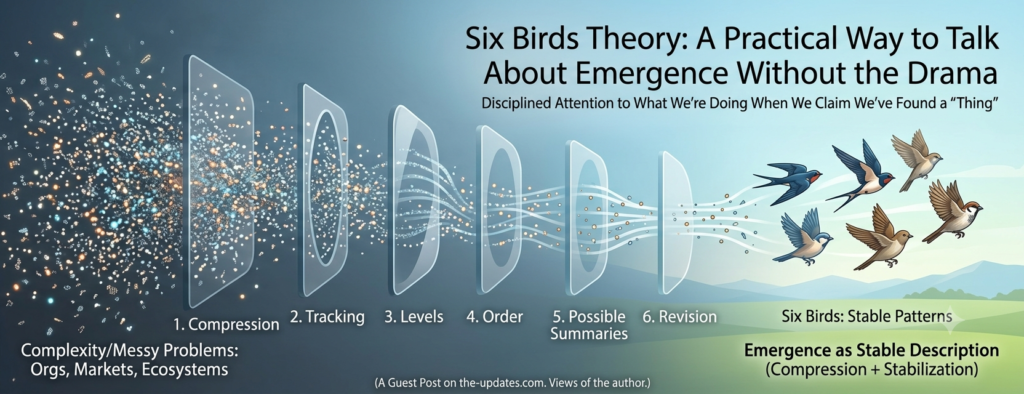
Six Birds Theory: A Practical Way to Talk About Emergence Without the Drama
If you’ve spent any time around big, messy problems—organizations, markets, ecosystems, even families—you’ve heard some version of this sentence: “It just emerged.”
It’s usually said with a shrug, like emergence is a fog we can’t penetrate. Something appears at the surface that nobody planned, and we treat it like a minor miracle: culture, trends, habits, stability, chaos, coordination, collapse.
What I like about Six Birds Theory (from Six Birds: Foundations of Emergence Calculus) is that it refuses the shrug. It doesn’t romanticize emergence, and it doesn’t flatten it into “it’s just complicated.” Instead it offers a structured way to talk about what we’re actually doing when we claim higher-level patterns exist.
And honestly, it feels less like a metaphysical argument and more like good professional hygiene: define your lens, know what you’re ignoring, and don’t confuse your summary with the full story.
The core idea, in everyday terms
We don’t experience reality in full resolution.
We simplify. We group. We label. We create categories so we can make decisions before dinner gets cold.
Six Birds Theory starts from that very normal fact and builds outward. It says: if your access to a system is limited (which it always is), you will inevitably “compress” it into a simpler description. You’ll also inevitably “clean up” that description so it becomes stable and usable.
That stability is the point.
In the paper’s language, an “object” isn’t something mystical hiding underneath reality. An object is what you get when your description stops changing under your own rule for making it consistent. It’s like editing a document until further edits don’t improve anything. That final version is what you ship.
So emergence becomes something like this: a stable pattern created by compression plus stabilization.
Why this framework matters (and why it feels timely)
When people talk about emergence, there’s a constant temptation to jump from “our model is simplified” to “the system must be irreversible” or “the pattern must be fundamental.”
Six Birds is careful in a way I respect. It draws lines that many conversations blur:
- Stability is not the same as truth.
- A useful category is not automatically a natural kind.
- Losing information is not automatically an arrow of time.
- A clean macro-story is not guaranteed just because we want one.
This isn’t pessimism. It’s honesty. And honesty is what makes a framework portable—useful across physics, AI, economics, or any place where we’re forced to summarize complexity.
The “Six Birds,” translated into how humans actually work
The paper identifies six structural features that tend to appear when you build layered descriptions. You can read them as six reminders that keep your emergence story grounded.
First, you compress. You decide that many details will count as “the same.” That’s how you get concepts like “temperature,” “customer segment,” or “mood.” Without compression, you drown in specifics.
Then you track what survives compression. Once you’ve simplified, you need some kind of audit trail—numbers or invariants that behave predictably when you zoom out. You want to know what you lost and what you kept.
You also build levels. You don’t just have one zoom setting; you have many. You move between micro and macro depending on what you’re trying to do. In real life, this is the difference between “how did this happen today?” and “what’s the pattern over a year?”
And then the uncomfortable parts show up.
Sometimes order matters. If you update the system first and then compress, you can get a different result than if you compress first and then apply the update at the macro level. That mismatch is not a philosophical detail; it’s a warning. It means your abstraction isn’t aligned with how the system moves.
Sometimes not every summary is even possible. We can imagine a neat “macro-state,” but the system might not be able to produce it from any real micro-state. In practice, that’s the gap between a clean dashboard and what the data can actually support.
And sometimes you’re forced to revise your description. This is the part people often avoid: if your macro story leaks—if the high-level rules secretly depend on details you threw away—then you don’t get to call it a macro law. You either refine your lens, change your model, or admit you’re not at the right level yet.
That last piece is, to me, the most grown-up part of the theory. It doesn’t promise that higher levels will always behave nicely. It gives you a way to recognize when they don’t.
The best section: how it keeps you honest about time and irreversibility
There’s a common trap in these conversations, and it goes like this: “Once you coarse-grain, you can’t reverse things, therefore time has an arrow.”
But losing information in your description is not the same as the world being fundamentally irreversible. Six Birds separates the two.
It uses an information-theoretic audit on histories (not just states) to define what “arrow of time” means in a rigorous way. And it makes a strong point: if you blur your view, you should not be able to artificially increase the evidence for irreversibility. If it looks like you did, you probably hid part of the mechanism—like an external schedule or protocol—and then blamed the system for the mismatch.
If you’ve ever sat in a meeting where a metric “proved” something and you later learned the data pipeline was wrong, you already understand the spirit here.
What you can do with this idea
You don’t have to be a physicist to get value out of Six Birds. It’s really a framework for anyone who builds narratives on top of complexity.
If you work in tech, it’s a reminder that representations and dashboards are not neutral—they create “objects” by compression, and those objects can drift if your underlying dynamics don’t respect your abstraction.
If you work in organizational life, it’s a reminder that “culture” and “alignment” are emergent objects too: stable patterns created by limited perspectives, repeated routines, and the way feedback loops settle.
If you like philosophy, it’s a contemporary way to talk about how categories become real in practice: not as eternal essences, but as stable fixed points under a shared way of describing.
A closing thought
At 40, I’ve become less interested in frameworks that sound profound and more interested in frameworks that help people stop fooling themselves.
Six Birds Theory is in that second category. It doesn’t tell you what reality “really is.” It tells you how to build higher-level explanations responsibly: compress, stabilize, and audit. And when the model leaks, treat it as information—not embarrassment.
That’s a surprisingly calming way to think about emergence calculus.
Not magic. Not reductionism. Just disciplined attention to what we’re doing when we claim we’ve found a “thing.”
Disclaimer:
This is a guest post published on the-updates.com. The views expressed are those of the author and do not necessarily reflect the views of the website.


Top Universities
 ANU University
  Monash University
  University of Oxford
  Daad
Daad  Istituto Marangoni London
  Southern Cross University
  University of British Columbia (UBC)
  UCLouvain
  Pierre Elliott Trudeau Foundation
  University of Florence
 Recent Post

SarkariNetwork – Government Jobs, Exam Alerts & Scholarship...
Read More 

Is Arizona State University (ASU) Accredited?
Read More

Is Full Sail University Legit?
Read More

Is National University Accredited?
Read More

Work and Travel in Canada with the IEC...
Read More

The Practical Guide to GD&T Training: What It...
Read More

CMMS and Preventive Maintenance Software Solutions Guide
Read More

Boston wedding venues
Read More

What Is an Artificial Intelligence (AI) Death Calculator
Read More

How Cloud Services Are Transforming Businesses in Reading,...
Read More

How Learning Skills with AI
Read More

6 Timeless Skills That Will Always Be in...
Read More























0 Comments
No comments yet.