



Germany Job Seeker Visa 2026 (Academic & Non-Academic): Complete Guide

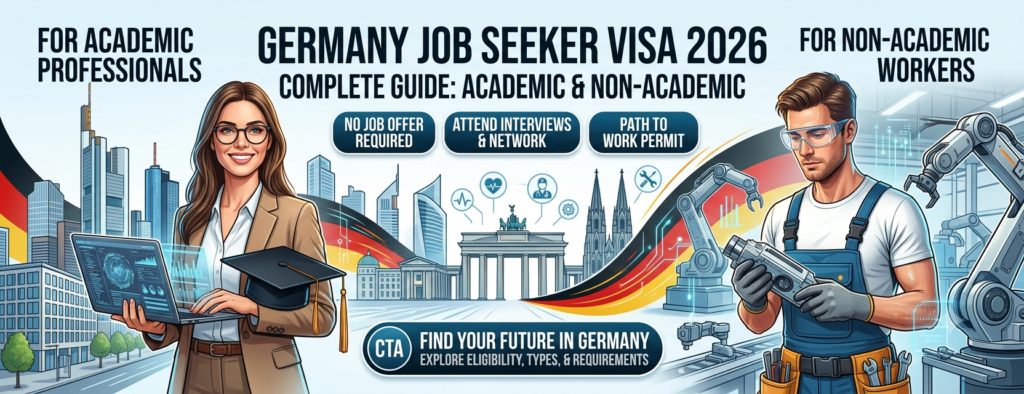
Germany Job Seeker Visa 2026 (Academic & Non-Academic): Complete Guide
Germany remains one of the most attractive destinations for skilled professionals seeking international career opportunities. With a strong economy, labor shortages across multiple industries, and competitive salaries, the country continues to welcome qualified foreign workers through various immigration pathways.
One of the most popular options is the Germany Job Seeker Visa, which allows eligible foreign nationals to travel to Germany without having a job offer in advance. Once in Germany, applicants can search for employment, attend interviews, network with employers, and, after securing a suitable position, apply for a work permit or residence permit.
In 2026, Germany continues to offer opportunities for both academic professionals with university degrees and non-academic skilled workers with recognized vocational qualifications. However, applicants should also be aware of the Opportunity Card (Chancenkarte), which has become an additional pathway for many international job seekers.
This comprehensive guide explains everything you need to know about the Germany Job Seeker Visa in 2026, including eligibility requirements, visa types, required documents, financial requirements, application procedures, benefits, limitations, and frequently asked questions.
What Is the Germany Job Seeker Visa?
The Germany Job Seeker Visa is a long-term national visa that allows qualified foreign nationals to enter Germany for the purpose of finding employment.
Unlike a traditional work visa, applicants do not need a job offer before applying. Instead, they can travel to Germany, explore employment opportunities, attend interviews, meet employers, and apply for jobs during their authorized stay.
Once they obtain suitable employment related to their qualifications, they can apply for a German residence permit for employment without returning to their home country in many cases.
The Job Seeker Visa is particularly beneficial for professionals working in sectors experiencing labor shortages, including:
- Engineering
- Healthcare
- Information Technology (IT)
- Manufacturing
- Skilled Trades
- Construction
- Logistics
- Hospitality
- Research
- Education
Germany Job Seeker Visa vs Opportunity Card (2026)
Beginning in recent years, Germany introduced the Opportunity Card (Chancenkarte) as another route for skilled foreign workers.
Although both programs allow individuals to search for employment inside Germany, there are important differences.
| Germany Job Seeker Visa | Opportunity Card |
|---|---|
| Intended for applicants with recognized qualifications | Points-based immigration system |
| Usually valid for several months | Can provide greater flexibility |
| Requires proof of financial support | Financial proof also required |
| No job offer required | No job offer required |
| Suitable for academic and vocational professionals | Suitable for many skilled professionals meeting the points criteria |
Applicants should determine which pathway best matches their qualifications before applying.
Two Types of Germany Job Seeker Visa
Germany offers two primary categories depending on the applicant’s educational background.
1. Germany Job Seeker Visa (Academic)
The Academic Job Seeker Visa is intended for applicants who possess recognized university qualifications.
Typical eligible applicants include:
- Bachelor’s Degree holders
- Master’s Degree holders
- PhD graduates
- University professionals
The degree should generally be recognized or comparable to a German university qualification.
Applicants are expected to seek employment that matches their educational background.
2. Germany Job Seeker Visa (Non-Academic)
Germany also welcomes skilled workers who have completed recognized vocational education.
Applicants generally need:
- At least two years of vocational education or training
- Professional certification
- Relevant work experience
- Recognized occupational qualifications
This pathway benefits electricians, mechanics, technicians, plumbers, welders, caregivers, machine operators, cooks, drivers, and many other skilled workers.
Why Germany Needs Skilled Workers
Germany continues to experience shortages across many industries because of:
- Aging population
- Growing economy
- Increased retirement rates
- Expansion of healthcare services
- Demand for IT professionals
- Infrastructure development
- Manufacturing growth
These labor shortages create significant opportunities for qualified international workers.
Eligibility Requirements
Applicants must satisfy several eligibility conditions before applying.
General requirements include:
- Valid passport
- Non-EU/EEA citizenship
- Relevant academic or vocational qualifications
- Recognized qualifications where required
- Professional work experience
- Financial proof
- Genuine intention to find employment
- Clean immigration history
Meeting the minimum requirements does not automatically guarantee visa approval, as each application is assessed individually.
Academic Job Seeker Visa Requirements
Applicants with university degrees generally need:
- Recognized Bachelor’s or Master’s degree
- Degree comparable to German standards
- Relevant work experience
- Financial resources
- Health insurance
- Motivation to seek employment
University graduates from engineering, computer science, finance, healthcare, business administration, architecture, and similar disciplines often have strong employment prospects.
Non-Academic Job Seeker Visa Requirements
Applicants with vocational qualifications typically require:
- Recognized vocational training
- Professional certification
- Skilled work experience
- Financial support
- Health insurance
- Occupation recognized under German regulations
Vocational professionals are increasingly needed across Germany due to shortages in technical occupations.
Required Documents
Although document requirements may differ slightly between embassies, applicants generally need:
- Completed visa application form
- Valid passport
- Recent passport-size photographs
- Updated CV or résumé
- Cover letter explaining employment plans
- Educational certificates
- Vocational certificates (if applicable)
- Professional experience letters
- Financial proof
- Health insurance
- Accommodation details (if available)
- Visa fee payment receipt
All foreign documents may require certified translations depending on the country of application.


Top Universities
 Monash University
  Daad
Daad  University of Oxford
  ANU University
  Istituto Marangoni London
  Yale University
  University of Warwick
  University of British Columbia (UBC)
  Umeå University
  Southern Cross University
 Recent Post

Common Scholarship Rejection Reasons
Read More 

How to Check If a Scholarship Is Fake...
Read More

How to Find Professor Email for MS/PhD Admissions...
Read More

Universities That Accept Students Without IELTS in 2026
Read More

Duke-NUS AI Medical Education Faculty Position 2026
Read More
Frontier AI Security Residency 2026 in UK (Fully...
Read More
SarkariNetwork – Government Jobs, Exam Alerts & Scholarship...
Read More
Is Arizona State University (ASU) Accredited?
Read More
Is Full Sail University Legit?
Read More
Is National University Accredited?
Read More

Work and Travel in Canada with the IEC...
Read More

The Practical Guide to GD&T Training: What It...
Read More























0 Comments
No comments yet.