



How to Get Band 8 in IELTS in 2026

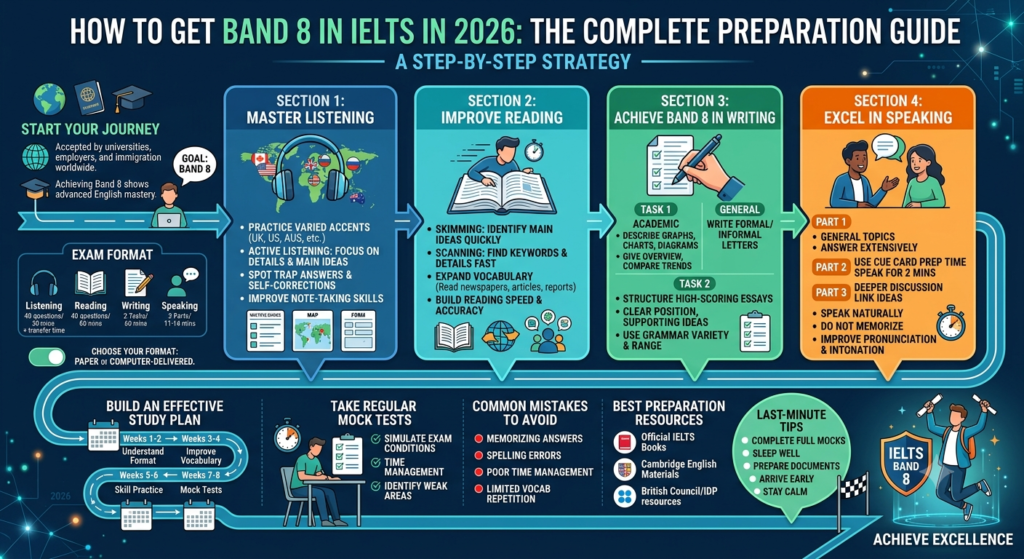
Scoring Band 8 in the IELTS exam is an achievable goal with the right preparation, consistent practice, and smart exam strategies. Whether you are applying for admission to an international university, immigrating to countries such as Canada, Australia, New Zealand, or the UK, or seeking professional registration, a Band 8 score can significantly strengthen your application.
The IELTS exam continues to be one of the world’s most recognized English language proficiency tests. In 2026, the test maintains the same four core modules, while offering greater flexibility through computer-delivered IELTS, improved test center experiences, and faster result delivery in many locations.
This comprehensive guide explains exactly how to prepare for every section of the IELTS exam and maximize your chances of achieving a Band 8 or higher.
What is IELTS?
The International English Language Testing System (IELTS) evaluates a candidate’s ability to communicate effectively in English. It is accepted by thousands of universities, employers, licensing bodies, and immigration authorities worldwide.
There are two IELTS test types:
- IELTS Academic
- IELTS General Training
Both versions assess four language skills:
- Listening
- Reading
- Writing
- Speaking
IELTS Exam Format 2026
Understanding the IELTS exam structure is the first step toward success.
| Module | Time | Questions |
|---|---|---|
| Listening | Approximately 30 minutes + transfer time (paper) | 40 |
| Reading | 60 minutes | 40 |
| Writing | 60 minutes | 2 Tasks |
| Speaking | 11–14 minutes | 3 Parts |
Paper-Based vs Computer-Delivered IELTS
Today, candidates can choose between:
- Paper-Based IELTS
- Computer-Delivered IELTS
Both formats:
- Have identical questions
- Use the same marking criteria
- Award exactly the same certificate
- Are accepted equally by universities and immigration authorities
Many candidates now prefer computer-delivered IELTS because results are generally available faster and typing may be quicker than handwriting.
How IELTS is Scored
Each module receives a band score from 0 to 9.
Your overall score is the average of:
- Listening
- Reading
- Writing
- Speaking
To achieve Band 8, you typically need:
- Very few grammar mistakes
- Wide vocabulary
- Excellent comprehension
- Strong organization
- Natural fluency
- Clear pronunciation
Section 1: Master the IELTS Listening Test
Listening often becomes one of the highest-scoring modules for Band 8 candidates because it can be improved significantly through regular practice.
Understand the Four Listening Sections
The recording progresses from easier to more challenging conversations.
You may encounter:
- Multiple choice
- Matching
- Maps
- Labelling diagrams
- Sentence completion
- Form completion
- Summary completion
- Short-answer questions
Best Listening Preparation Strategies
Practice Different English Accents
IELTS recordings include:
- British English
- Australian English
- American English
- Canadian English
- New Zealand English
Listening to only one accent may limit your comprehension.
Improve Active Listening
Rather than simply hearing English, focus on:
- Main ideas
- Supporting details
- Numbers
- Dates
- Names
- Directions
Learn Common Trap Answers
IELTS often includes distractors where speakers correct themselves.
Example:
“I’ll arrive on Tuesday… actually, make that Wednesday.”
Only the final information is correct.
Build Note-Taking Skills
Practice writing:
- Keywords
- Symbols
- Abbreviations
without missing the next part of the recording.
Section 2: Improve Your IELTS Reading Score
The Reading section challenges both speed and comprehension.
Academic passages often include scientific, historical, and technical topics.
General Training passages focus more on workplace and everyday situations.
Skimming
Read quickly to identify:
- Main idea
- Paragraph purpose
- Overall structure
Scanning
Look for:
- Dates
- Names
- Statistics
- Keywords
- Specific phrases
This saves valuable time.
Expand Your Vocabulary
Read daily from:
- Newspapers
- Academic articles
- Business magazines
- Scientific publications
- University websites
Record:
- New vocabulary
- Synonyms
- Collocations
Vocabulary knowledge is one of the strongest predictors of Reading success.
Section 3: Achieve Band 8 in IELTS Writing
Writing remains the lowest-scoring module for many candidates.
The key is understanding the official marking criteria.
Examiners assess:
- Task Achievement
- Coherence and Cohesion
- Lexical Resource
- Grammatical Range and Accuracy
Each criterion contributes equally to your score.
IELTS Academic Writing Task 1
You may describe:
- Bar charts
- Pie charts
- Line graphs
- Tables
- Maps
- Process diagrams
Tips
- Write an overview.
- Compare key trends.
- Avoid personal opinions.
- Use accurate data.
- Organize information logically.
IELTS General Training Task 1
Candidates write:
- Formal letters
- Semi-formal letters
- Informal letters
Always identify:
- Purpose
- Audience
- Appropriate tone
Writing Task 2
Task 2 carries more weight than Task 1.
Common essay types include:
- Opinion essays
- Discussion essays
- Problem-solution essays
- Advantages and disadvantages
- Double-question essays
High-Scoring Essay Structure
Introduction
- Paraphrase the question
- Present your position
Body Paragraph 1
- Topic sentence
- Explanation
- Example
Body Paragraph 2
- Topic sentence
- Supporting ideas
- Real-life example
Conclusion
- Summarize your position
- Avoid introducing new ideas
Grammar for Band 8
Use a variety of structures:
- Complex sentences
- Relative clauses
- Conditional sentences
- Passive voice
- Linking devices
Avoid trying to sound overly academic if accuracy suffers.
Section 4: Excel in IELTS Speaking
The Speaking test lasts approximately 11–14 minutes.
It consists of three parts.
Part 1
General questions about:
- Family
- Work
- Studies
- Hobbies
- Daily life
Part 2
You receive a cue card.
You have:
- 1 minute to prepare
- Up to 2 minutes to speak
Part 3
A deeper discussion related to Part 2.
Speaking Tips for Band 8
Speak Naturally
Do not memorize answers.
Examiners quickly recognize rehearsed responses.
Expand Your Answers
Instead of saying:
“Yes.”
Say:
“Yes, I enjoy reading because it helps me relax after work and improves my vocabulary.”
Improve Pronunciation
Focus on:
- Stress
- Intonation
- Rhythm
- Clear sounds
Perfect native pronunciation is not required.
Section 5: Build an Effective IELTS Study Plan
Consistency matters more than studying for long hours occasionally.
8-Week Study Schedule
Weeks 1–2
- Understand exam format
- Learn question types
- Take a diagnostic test
Weeks 3–4
- Improve vocabulary
- Practice Listening and Reading daily
Weeks 5–6
- Focus on Writing Task 1 and Task 2
- Complete Speaking practice sessions
Weeks 7–8
- Take full-length mock tests
- Review mistakes
- Improve weak areas
Section 6: Take Regular IELTS Mock Tests
Mock exams prepare you for real test conditions.
Benefits include:
- Better time management
- Improved concentration
- Reduced exam anxiety
- Accurate score prediction
- Identification of weak areas
Always review every mistake after each practice test.
Common Mistakes That Prevent Band 8
Avoid these frequent errors:
- Memorizing essays
- Ignoring spelling mistakes
- Poor time management
- Writing fewer than the required words
- Giving one-word speaking answers
- Guessing without reading instructions carefully
- Limited vocabulary repetition
- Lack of grammar variety
Best IELTS Preparation Resources in 2026
For reliable preparation, use official and high-quality materials such as:
- Official IELTS Practice Tests
- Cambridge IELTS books
- British Council preparation resources
- IDP IELTS practice materials
- Official IELTS Ready platform
- IELTS by Cambridge online practice
Using official materials ensures you become familiar with real exam standards and question formats.
Last-Minute Tips Before Your IELTS Exam
One week before your test:
- Complete one full mock test every two days.
- Review grammar and vocabulary.
- Practice speaking every day.
- Sleep well.
- Avoid learning entirely new material.
- Prepare your identification documents.
- Arrive at the test center early.
Staying calm and confident can have a positive impact on your overall performance.
Final Thoughts
Achieving Band 8 in IELTS is not about memorizing answers or using complicated vocabulary. It is about developing strong English language skills, understanding the exam format, and practicing consistently with official materials.
By following a structured study plan, mastering each module individually, and regularly evaluating your progress through mock tests, you can significantly improve your chances of earning an excellent IELTS score in 2026. Whether your goal is studying abroad, immigrating, or advancing your career, disciplined preparation and smart exam strategies will help you perform at your best on test day.


Top Universities
 Monash University
  Daad
Daad  University of Oxford
  ANU University
  Istituto Marangoni London
  Yale University
  University of Warwick
  University of British Columbia (UBC)
  Umeå University
  Southern Cross University
 Recent Post

Common Scholarship Rejection Reasons
Read More 

How to Check If a Scholarship Is Fake...
Read More

How to Find Professor Email for MS/PhD Admissions...
Read More

Universities That Accept Students Without IELTS in 2026
Read More

Duke-NUS AI Medical Education Faculty Position 2026
Read More

Frontier AI Security Residency 2026 in UK (Fully...
Read More
SarkariNetwork – Government Jobs, Exam Alerts & Scholarship...
Read More

Is Arizona State University (ASU) Accredited?
Read More

Is Full Sail University Legit?
Read More
Is National University Accredited?
Read More

Work and Travel in Canada with the IEC...
Read More

The Practical Guide to GD&T Training: What It...
Read More























0 Comments
No comments yet.